
Back to all walkthroughs


Supervising AI-Assisted Investigations
Premium roomAudit an AI-prepared SOC conclusion in Elastic, test it against the evidence, and correct the Case.
medium
To access material, start machines and answer questions login.
When an -assisted workflow writes the conclusion on a Case, an analyst still has to decide whether that conclusion is right before anyone acts on it. In this room, we take over a Case that an assistive workflow has already concluded. We will trace how its conclusion was produced, test it against the native Elastic evidence, and correct the record before it reaches Tier 2.
Incident Scenario
Let's start with the handover as it reached the Tier 1 queue:
Northbridge Finance Group: Security Operations, 02:17
The night analyst reviewed a service-account logon alert and left NFG-CASE-2047 open. An assistive workflow wrote the note in it, saying no persistence occurred on NFG-FS-01 in the 28 July 2026 window.
The note is well formed and its references resolve. Nobody has checked whether its searches were wide enough to support a claim about the of the host.
Don't repeat the triage. Work out how that conclusion was produced and test it against the evidence.
The workflow spared the night shift two jobs by running the searches and drafting a note that cites each lookup it used. From here we act as the workflow's supervisor and practise deciding how much of a conclusion the evidence can carry.
What We Will Investigate
The evidence we need is spread across three indices: the Windows events collected from the affected hosts, the recorded trace of the workflow that wrote the note, and the manifest describing what was collected in the first place.
We'll follow a single thread through all three. We'll open the Case, follow its run reference into the trace, read the searches that the trace recorded, reproduce the important one in Discover, then compare what it covered against what was collected. The room ends with a correction written back into the Case and a handover prepared for Tier 2.
The Model's Access
The language model in this workflow had no Elasticsearch credentials, so it could not search events, edit the Case, or set an investigation status. It received written summaries of the lookups and drafted the note from them.
The trace keeps only a hash of those summaries, and we cannot read what the model was given. We can still test whether the note's conclusion stays inside the scope of the searches it cites, and we follow that question through every task.
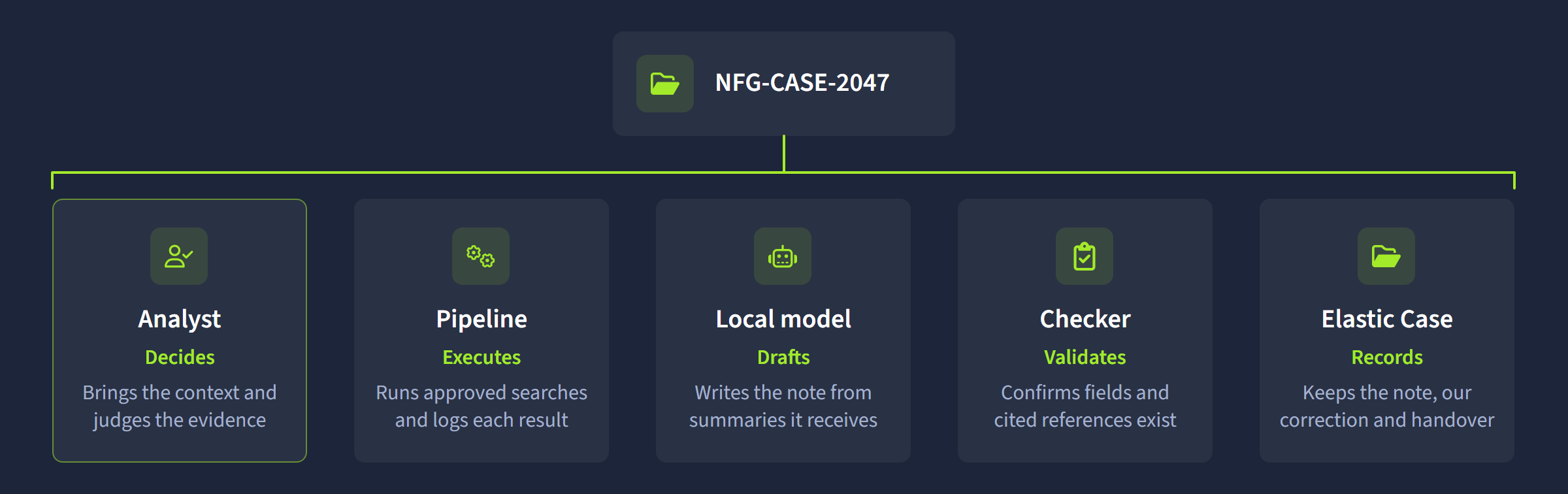
Each part of the workflow that touches the Case has one job, and only the analyst decides what the evidence supports:
Learning Objectives
By the end of this room, we will be able to:
- Read a recorded workflow and separate the human, model, and validator steps.
- Tell a traceable claim from a claim the recorded evidence supports.
- Run a supplied query and state the limits its filters and the time picker place on the result.
- Judge a claim against the scope it states, and record the activity status as a separate decision.
- Correct a Case without overclaiming, and prepare a Tier 2 handover carrying the open questions.
Prerequisites
This room builds on the Security Operations Centre () groundwork taught earlier in the path, so we should complete the following room first:
- AI in the Modern SOC covers reading an Elastic Case and checking a generated observation against the records behind it.
This room also expects familiarity with Kibana Discover, including its time picker and query editor, which Elastic Stack: The Basics covers as part of the Elasticsearch, , and Kibana () stack. No query writing is needed, because each Elasticsearch Query Language () query is supplied and explained where it appears.
Answering the Questions
Every answer comes from Elastic, from the supervision receipt we open next, or from one of the status labels the tasks define, and is accepted in any letter case.
Answer the questions below
Let's begin!
Ready to learn Cyber Security?
The Supervising AI-Assisted Investigations room is only available for Premium or Max subscribers. Signup now to access more than 500 free rooms and learn cyber security through a fun, interactive learning environment.
Already have an account? Log in